
AI Over Earnings
AI Washing and How CEOs are Eroding Trust Everywhere

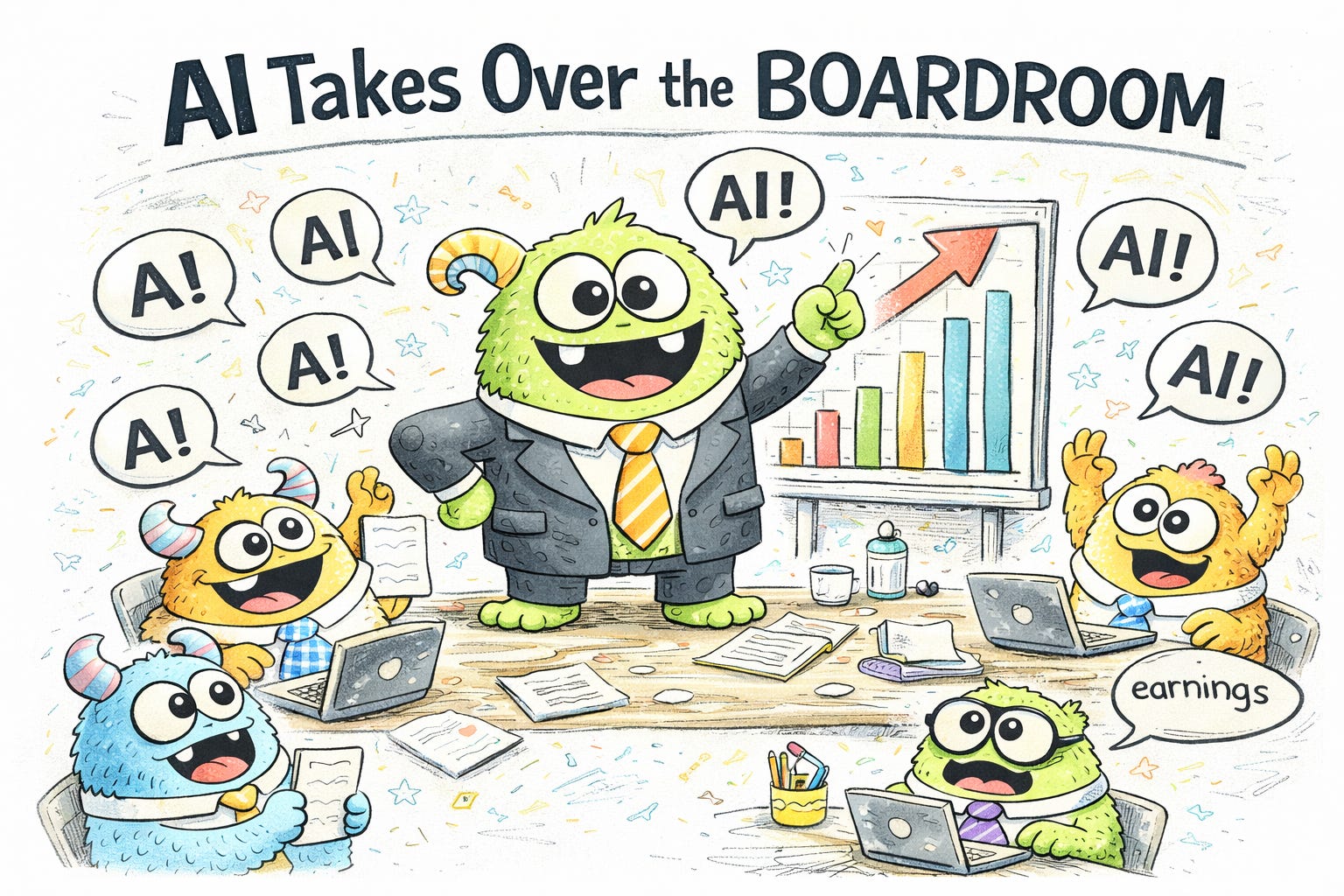
In the recent 4th-quarter earnings calls, 331 (66%) S&P 500 companies mentioned “AI,” with the term being used more frequently (4927 times) than “earnings” (3666 times), according to Bloomberg’s AI-powered earnings call summary app, the Terminal.
Interestingly, half of all CEOs express concern for their jobs if they don’t implement effective AI strategies this year, and 74% fear job loss if they fail to deliver measurable AI-driven gains by the end of 2027. However, research from the National Bureau of Economic Research reveals a surprising trend: 69% of CEOs, CFOs, and senior executives use AI at work for less than an hour a week, while 28% do not use it at all. I wonder, how can we mandate what we aren’t willing to do ourselves?
Read the research here: http://www.nber.org/papers/w34836
While CEOs double down on AI use, many employees secretly resist it. Conversations I’m having daily reveal a common theme: ineffective corporate change management, slow, irrelevant training, and top-down communication that often feels more like a threat than encouragement are not helping.
The old Playbooks aren’t working and are prime for disruption.
What we’re witnessing isn’t an “AI adoption problem.” It’s an organizational design problem. Companies are trying to bolt AI onto structures, incentives, and workflows that were never built for it. They’re treating AI like software procurement when it’s actually a shift in how work gets done, how decisions get made, and how value is created.
Most organizations are still operating with:
• 20th‑century hierarchies trying to manage 21st‑century technology
• Training models built for compliance, not capability
• Change management that assumes people fear technology, when in reality they fear being left behind without support
• Leaders who talk about AI transformation but don’t model AI fluency in their own daily work
This gap — between what leaders say and what organizations do — is where AI initiatives quietly stall.
And as Megan Poinski, Forbes Staff Writer, points out in her article, “Why ‘AI Washing’ Is A Huge Risk For Your Company”, new consequential issues become part of a CEO’s slate of responsibilities. With AI’s growth and development, companies now have to guard against AI washing: exaggerating AI capabilities to inflate and attract valuation and investment. It’s a new problem, but could be serious, leading to litigation, investor complaints and loss of insurance.
The truth is, AI transformation doesn’t fail because the technology isn’t ready. It fails because the humans and the systems around them aren’t aligned. Employees don’t resist AI; they resist unclear expectations, poorly designed workflows, and the sense that AI is something being done to them rather than built with them.
What companies need now isn’t another mandate or another “AI strategy deck.”
They need new operating models that make AI usable, trustworthy, and integrated into the real work people do every day.
They need:
• Task-level clarity, not job-level fear
• Hands-on fluency, not theoretical training
• Transparent governance, not vague guardrails
• Leaders who practice what they preach, not just talk about transformation
• Systems that reward experimentation, not perfection
AI won’t be adopted because executives insist on it.
It will be adopted when organizations make it safe, practical, and valuable for people to use — starting with the leaders themselves.
And that’s the opportunity in front of us: to replace outdated playbooks with human-centered, task-driven, transparent AI operating systems that actually work.